
Online Offers Must Show the Lowest Price of the Last 30 Days

NBT Report, New Delhi
In online shopping and booking, companies will now be held accountable for practices that may mislead customers. The government has tightened rules for e-commerce companies and introduced requirements to clearly disclose information related to prices, offers, products, and services. The new rules will come into effect from 1 January 2027.
Companies will have to ensure that customers can easily access all important information before making a purchase. Whenever a discount is displayed on a product, the company must also show the lowest price at which the product was sold during the previous 30 days. The presentation of search results and sponsored products must also remain transparent.
Companies will not be allowed to use customers’ information for other purposes without their clear consent. E-commerce companies will also be required to connect with the National Consumer Helpline. These measures are intended to make online shopping terms easier for consumers to understand and help protect them from unfair or misleading practices.
Companies Will Have to Check Their Own Use of Dark Patterns
In its 2023 guidelines, the government identified 13 types of dark patterns. These include basket sneaking, forced action, subscription traps, bait and switch, trick questioning, and deceptive wording.
E-commerce companies will now be required to conduct a self-audit of their platforms once every year and certify that they are complying with the rules designed to prevent such practices.
Government Amends E-Commerce Rules to Prevent Price Manipulation
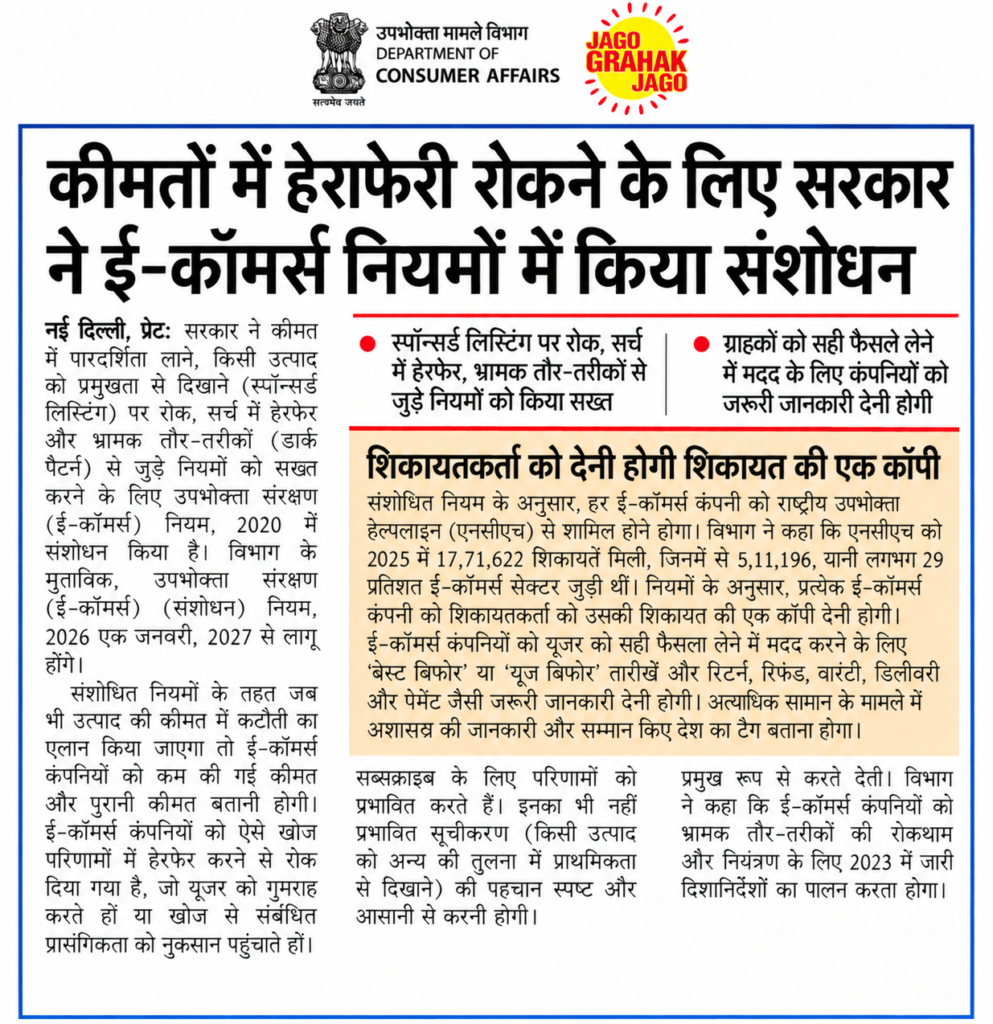
New Delhi, PTI: The government has amended the Consumer Protection (E-Commerce) Rules, 2020 to strengthen regulations related to price transparency, sponsored listings, manipulation of search results, and misleading practices known as dark patterns.
According to the department, the Consumer Protection (E-Commerce) (Amendment) Rules, 2026 will come into effect from 1 January 2027.
Under the amended rules, whenever a reduction in the price of a product is announced, e-commerce companies will have to disclose both the reduced price and the previous price.
E-commerce companies will also be prohibited from manipulating search results in ways that may mislead users or reduce the relevance of results related to a user’s search.
Key Points
- Rules concerning sponsored listings, search manipulation, and misleading practices have been made stricter.
- Companies will have to provide customers with the necessary information to help them make informed decisions.
A Copy of the Complaint Must Be Provided to the Complainant
Under the amended rules, every e-commerce company will be required to connect with the National Consumer Helpline (NCH).
The department stated that the NCH received 1,771,622 complaints in 2025, of which 511,196, or approximately 29%, were related to the e-commerce sector.
According to the rules, every e-commerce company will also have to provide the complainant with a copy of their complaint.
To help users make informed decisions, e-commerce companies will be required to provide important information such as “Best Before” or “Use Before” dates, as well as details regarding returns, refunds, warranties, delivery, and payments.
In the case of imported products, companies will also have to disclose information about the importer and the country of origin of the product.
Sponsored listings, where a product is given priority over other products, will have to be clearly and prominently identified.
The department also stated that e-commerce companies will have to comply with the 2023 guidelines issued for the prevention and regulation of misleading practices and dark patterns.
Clampdown on Price Manipulation
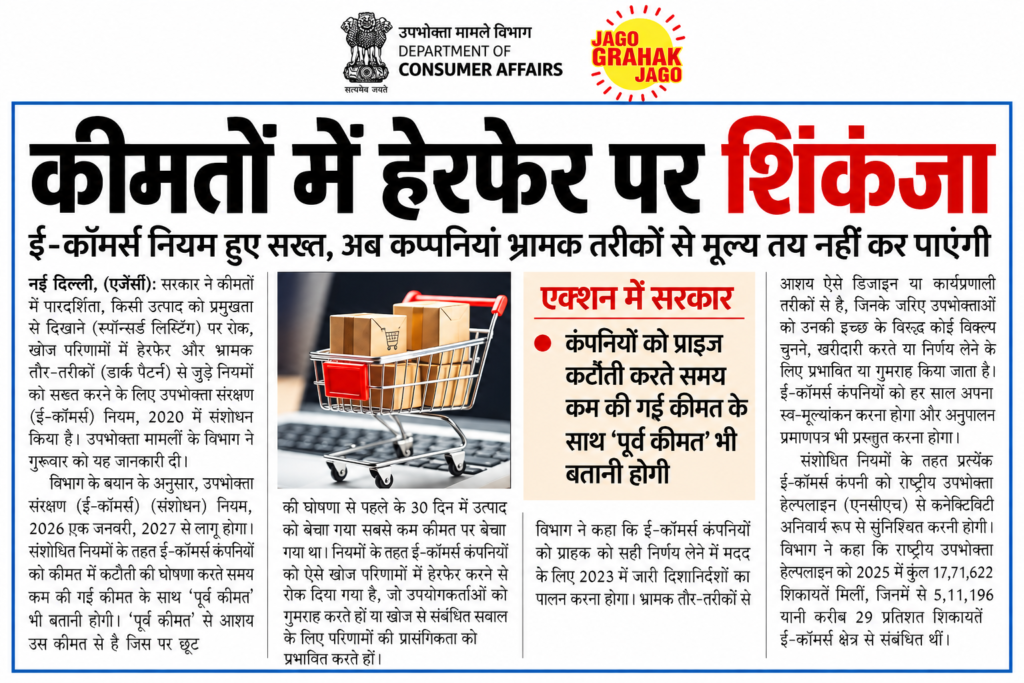
E-Commerce Rules Tightened; Companies Will No Longer Be Able to Determine Prices Through Misleading Practices
New Delhi (Agency): The government has amended the Consumer Protection (E-Commerce) Rules, 2020 to strengthen provisions relating to price transparency, sponsored listings, manipulation of search results, and misleading practices known as dark patterns. The Department of Consumer Affairs provided this information on Thursday.
According to the department, the Consumer Protection (E-Commerce) (Amendment) Rules, 2026 will come into effect from 1 January 2027.
Under the amended rules, whenever an e-commerce company announces a reduction in the price of a product, it will be required to display the “previous price” along with the reduced price.
The “previous price” refers to the relevant price at which the product was sold during the 30 days preceding the announcement of the discount, so that consumers can properly assess whether the advertised discount is genuine.
E-commerce companies will also be prohibited from manipulating search results in a way that misleads consumers or affects the relevance of results related to their search queries.
Sponsored listings—where certain products are given greater prominence or priority over others—will have to be clearly and prominently identified.
The department stated that e-commerce companies will also have to comply with the 2023 guidelines for the prevention and regulation of dark patterns.
Government Action
Companies must disclose the “previous price” along with the reduced price whenever announcing a price cut.
Dark patterns refer to designs or operational practices that influence or mislead consumers into choosing an option, making a purchase, or taking a decision that they may not otherwise have intended to make.
E-commerce companies will be required to conduct a self-assessment every year and submit a compliance certificate confirming adherence to the applicable rules.
Under the amended regulations, every e-commerce company will also be required to ensure mandatory connectivity with the National Consumer Helpline (NCH).
According to the Department of Consumer Affairs, the National Consumer Helpline received a total of 1,771,622 complaints in 2025. Of these, 511,196 complaints—approximately 29%—were related to the e-commerce sector.
Strict Rules Issued to Curb Manipulation by E-Commerce Companies
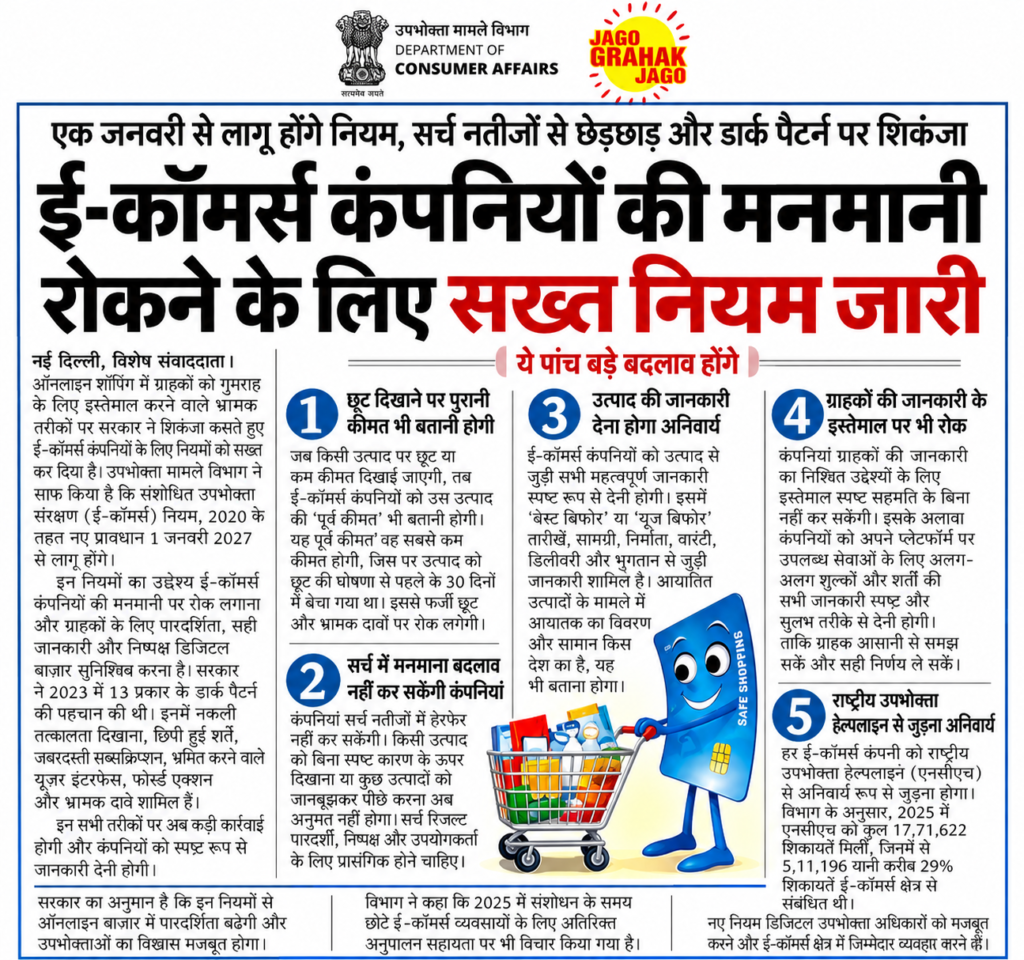
Rules will come into effect from 1 January; action against search-result manipulation and dark patterns
New Delhi: The government has tightened rules for e-commerce companies to curb misleading online shopping practices. According to the Department of Consumer Affairs, the amended Consumer Protection (E-Commerce) Rules, 2020 will come into effect from 1 January 2027.
The aim of these rules is to prevent manipulation by e-commerce platforms and provide consumers with greater transparency, accurate information, and a fair digital marketplace.
The government had earlier identified several types of dark patterns in 2023, including fake urgency, hidden conditions, forced subscriptions, manipulative user interfaces, and other misleading practices. Strict action may be taken against companies that violate these rules.
Five Major Changes
1. Previous price must also be shown when offering a discount
Whenever a product is shown at a discounted or reduced price, e-commerce companies will also have to display the product’s previous price.
The previous price will generally refer to the price at which the product was sold during the 30 days before the discount announcement. This is intended to prevent fake discounts and misleading promotional claims.
2. Companies will not be allowed to manipulate search results
E-commerce companies will not be permitted to unfairly manipulate search results or give certain products greater visibility without clearly explaining the reason.
Search results should remain transparent, fair, and relevant for consumers.
3. Complete product information will be mandatory
E-commerce platforms will be required to clearly provide all important information related to a product.
This includes details such as:
- Best Before / Use Before dates
- Return policy
- Refund policy
- Warranty
- Delivery information
- Payment-related information
For imported products, details of the importer and country of origin will also have to be disclosed.
4. Restrictions on the use of customer information
Companies will not be allowed to use customers’ personal information for specified purposes without clear consent.
They will also have to clearly disclose applicable charges, conditions, and other important information about services offered on their platforms so that consumers can make informed decisions.
5. Mandatory connection with the National Consumer Helpline
Every e-commerce company will be required to connect with the National Consumer Helpline (NCH).
According to the department, the NCH received 1,771,622 complaints in 2025, of which 511,196 complaints, or around 29%, were related to the e-commerce sector.
The government expects these measures to increase transparency in the online marketplace, strengthen consumer confidence, and reinforce digital consumer rights.